

Guadeloupe: the Smaller Islands
In search of my daily article, I came across this article from Le Figaro and I must admit that it was my favorite of the day; don't see any chauvinism on my part, but it must be said that this article is an ode to my island, so how could I not share it? I had to share it with you...
"Guadeloupe is an island. But it is also an archipelago that includes Les Saintes, Marie-Galante, and La Désirade. Dreamy small islands, on the paths of the discovery of the New World, that one visits with the curiosity and excitement of a butterfly hunter.
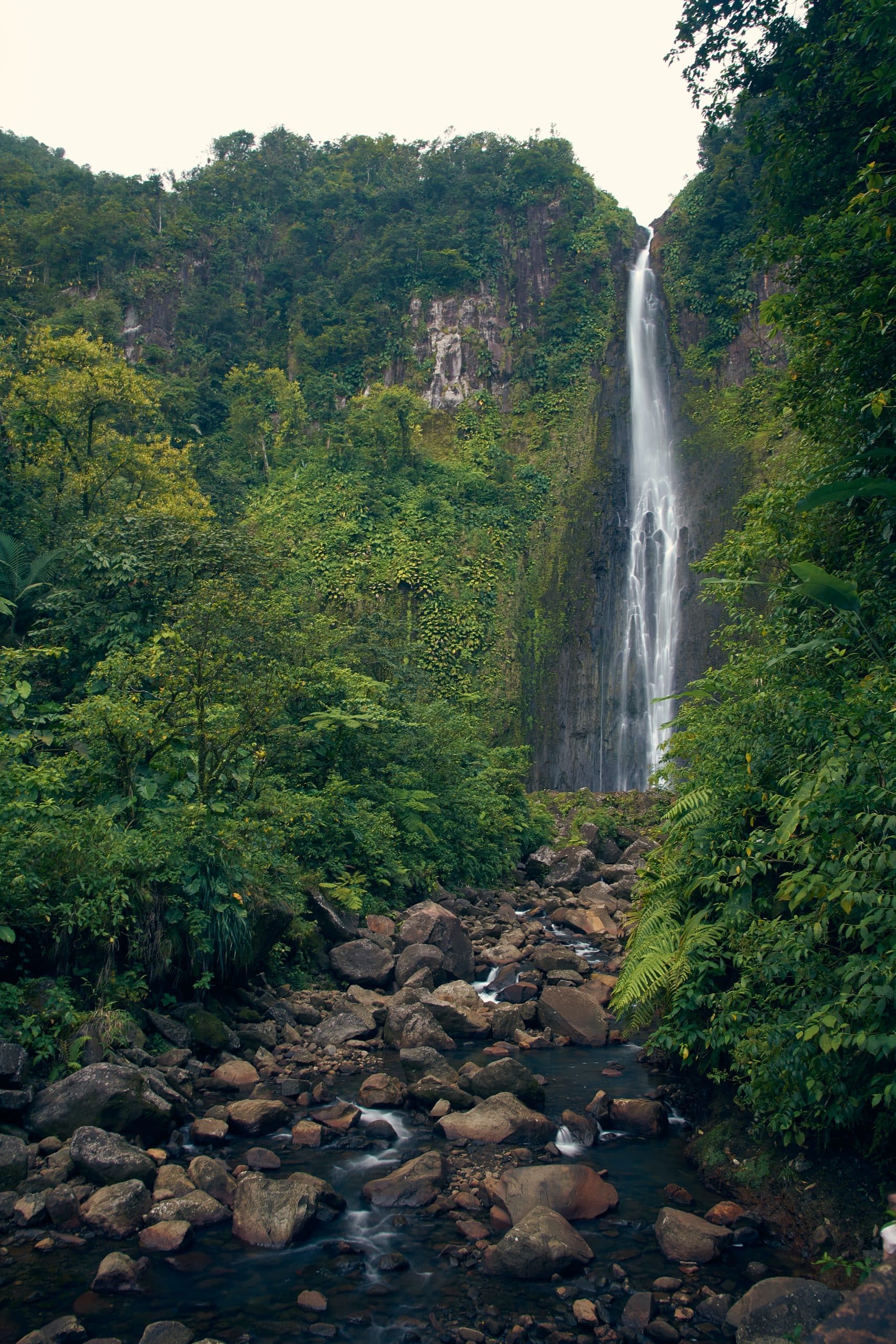
 "An tan lontan", a butterfly landed on the sea. Its wings were lagoon blue mixed with forest green. It was called Karukera, "the island of beautiful waters." In 1493, Christopher Columbus preferred the name Guadalupe. This did not change anything about the warm, turquoise waters of Grande-Terre or the tropical forest of Basse-Terre, its ever-congested volcano, its waterfalls, and its approximately 300 "traces" that allow for all kinds of hikes. "Greener than a dream," said Saint-John Perse of this "confetti of Empire." Here, we follow the road as it comes. We let ourselves be charmed by the Creole accent where "r"s become "w"s. We learn to recognize sapodillas, christophines, soursops. We let ourselves be told, at the Séverin estate, the history of agricultural rum and then, at La Grivelière, that of coffee. We dive around Îlet Pigeon in search of Jojo the Grouper. We swing under the canopy of the Mamelles Park and stroll through the sublime botanical garden of Deshaies. All that remains is to taste a crab matété, a fricassee of ouassous (large shrimp), or a goat colombo, because here one also travels through one's plate!
And then we remember that Guadeloupe is an archipelago. So we leave the "mainland" to "go up" to its "dependencies," these small southern islands with a scent of yesteryear. First, there is the archipelago of Les Saintes, toy islands with dollhouses adorned with red roofs and decorated with lambrequins. Terre-de-Haut Bay is one of the three most beautiful bays in the world, thanks in part to its "depths of seven to fifteen fathoms" where one could anchor without problem. Nine islets, two of which are inhabited: Terre-de-Haut and Terre-de-Bas. This is not a question of altitude but of orientation. As in Brittany, the bottom is to the west and the top to the east! The Saintois are very proud of their houses, these saffron, mango, anise-colored kas an nou, with essences patinated by time. Pascal Foy, nostalgic for these disappearing cases, reproduces their facades in pretty models. As for Edouard, a restaurateur and painter (but also a sailor at heart), he scours the coastline in search of wrecks from which he creates a beautiful "salty art." Are Les Saintes a land of artists? "Here," says Edouard, "a certain serenity reigns. We have time. We enjoy it." This is how these descendants of Breton or Poitevin sailors, like Césaire Pineau, go fishing for tuna, sea bream, and lobster, which passing gourmands will enjoy after walking the Crêtes trail, diving at Sec Pâté or Pointe à Vaches, visiting the sailors' chapel or Fort Napoléon and its small museum (it seems that each of its pillars hides a gold louis!) or stopping - when nature calls - in a "chalet de nécessité"... Beaches with clear waters where gorgonians and royal angels dance, lush vegetation where agaves, aloes, and "têtes à l'Anglais" (cacti) also grow, one cannot leave these blessed islands without tasting a "tourment d'amour," a small round cake filled with coconut. If only for the name of the lady who makes them: Celliette Appolinaire!
Between evening primroses and carapate oil, a colorful pharmacopoeia
Let's cross the sea once again and here we are in Marie-Galante, the "big galette." This beautiful island at sea is "the island of a hundred windmills," a name dating back to the golden age of sugarcane. They are all in ruins or decapitated except for the Bézard mill, skillfully restored with its slave huts made of woven cane. Nevertheless, three distilleries remain – Bielle, Bellevue, and Poisson – the latter producing the famous Père Labat rum at 59° by hand! Grand-Bourg, Saint-Louis, Capesterre, so many small villages with a tranquil charm from which one sets off, after passing the "rest center for the supine" (cemetery!), towards the Murat estate, a former sugar plantation, the Punch pond, Anse de Vieux-Fort for its sunset over La Soufrière, or one of the island's splendid beaches, such as La Feuillère or Les Basses. Did you know that Madame de Maintenon, daughter of the island's first governor, the Marquis d'Aubigné, probably built her first sandcastles there?
All that remains is to take a ride in Alex Brute's cabrouet or attend a "bœufs tirants" competition. Another tradition persists, that of cockfighting. Francky Mary, a breeder, tells us how these champions are coiffed, showered, massaged (with rum!) before competing every Sunday in a pitt à coqs with a competitor of the same weight and same bid. "The bets," he says, "can reach 2,300 euros..." Between two "punch bars," we will also learn that carapate oil cures colds; young guava leaves, stomach aches; evening primroses, sprains, not to mention the toxicity of manchineel fruits... "Marie-Galante so real," says the slogan. But for how long? Jean-Marc Tudor, a retired professor, doesn't mince words. "Life here is experienced as a delay and not as a rebound. We want to live like in France!" He adds, nostalgically: "We would so much like paradise to have a future..."
Françoise Sagan loved to stay on this protected island
Finally, there is the smallest and most authentic of Guadeloupe's "dependencies," La Désirade, infinitely natural. It is shaped like an overturned boat and also owes its name to Christopher Columbus, at the end of an exhausting journey. For a long time, "undesirable" lepers made their home there, as well as "bad subjects" who could have harmed their noble families... Today, there are goats, agoutis, iguanas, guaiacs, cashew trees, windmills, a Blowhole, and then suddenly, at the end of the road, a dry savanna, cliffs, an old weather station and its lighthouse. It looks like Ireland! Françoise Sagan loved to stay on this island with its protected biotope, in which perhaps a project should be defined today. Because "it is a fortune but everything remains to be done," says Théodore Compper, director of the Oualiri Beach hotel. But why do anything when you can do nothing?
A frigate hoists its wings into the blue sky. Frogs chirp like birds. Iguanas take themselves for dinosaurs. Flamboyant trees in bloom announce holidays and madras dance on the hips of tourists. Guadeloupe and its islands are obviously an archipelago kifoparaté! "
Source: le figaro.fr
by Catherine Caubère 05/12/2008 | Updated: 15:15
Read more
"In 200,000 years of existence, man has disrupted a balance created by nearly 4 billion years of Earth's evolution.The price to pay is heavy, but it's too late to be pessimistic: humanity has barel...
"Naked woman, black womanClothed in your color which is life, in your form which is beautyI grew up in your shadow; the softness of your hands bandaged my eyesAnd now in the heart of Summer and Noo...


Leave a comment
All comments are moderated before being published.
This site is protected by hCaptcha and the hCaptcha Privacy Policy and Terms of Service apply.