
What slows the growth of kinky and Afro hair
In this article, we share the causes that can slow down the growth of kinky hair. To do this, we will take a closer look at what makes up kinky hair, the elements of its natural environment, and the factors of hair loss, which directly hinder the natural growth of kinky hair.
Introduction to the characteristics of kinky and afro hair © Okhai Ojeikere
The hair fiber consists of 3 parts:
On the outside, the cuticle, formed by keratin scales interwoven like tiles, acts as a true protective shield. It is protected by a lubricant, sebum, which gives the hair its natural shine and fights against dehydration.
The second layer is the cortex, which determines the color, strength, elasticity, and texture of the hair. When the cortex is altered by chemical treatments, for example, it causes increased dryness.
Kinky hair has a helical shape that prevents sebum, secreted by the scalp, from spreading along the hair fiber. Consequently, it does not fulfill its role; our naturally dry hair then becomes ultra-dry and breaks where it is poorly hydrated.
The third and innermost layer is called the medulla.
Sources Diouda
Kinky hair in its natural environment
Initially, kinky hair is designed as a barrier against the sun. Nature, in this sense, has done things well:
• The hair is thick, very dense, twisted,
• It is flat and not round,
• It emerges from the dermis, lying along the skin of the scalp and not straight up.
Everything is therefore organized to not leave any part of the scalp exposed to sunburn. The scalp itself is adapted to high humidity climates: it is generally drier than a European-type scalp, the skin is thicker, and the pores are tighter.
Changes occurring in a European environment
Our hair breaks as it grows. This wrongly leads us to believe that it doesn't grow. In reality, kinky hair curls up on itself as it grows.
The only solution to stop the natural dryness of our hair and promote its growth is to avoid subjecting it to a battery of chemical and mechanical aggressions. Also, eat a healthy diet, hydrate it from the inside by taking daily borage and evening primrose oil capsules, and regularly apply moisturizing masks.
General hair loss factors
Hair loss can be due to usual general factors: a hormonal problem, stress, nutritional deficiency... Hair loss is also often linked to specific afro hairstyling practices: braids, extensions, relaxers. These two types of factors can affect the same hair.
1. Androgenetic hair loss
For kinky hair, it is less common and generally slower in its evolution than for Western hair types.
Almost always hereditary, it is due to a dysfunction of androgen hormones in the scalp and manifests as a thinning of the hair, followed by its gradual disappearance in well-defined areas of the head.
In men, it results in gradual baldness on the temples and vertex (tonsure), rarely total baldness. In women, it is located on the top of the head and the vertex and often appears during pregnancy or, much later, at menopause.
2. Hair loss due to stress
Stress, fatigue, or a violent emotional shock can cause diffuse hair loss over the entire head, or (sometimes for women) localized on the sides. After arriving in France, the distress caused by the change in climate and lifestyle habits is often the cause of this type of hair loss.
3. Hair loss due to iron deficiency
These are diffuse hair loss over the entire head, affecting women and beginning with a characteristic thinning of the keratin and the hair roots. More frequent among Afro-Caribbean women than among Western women, they should be systematically screened in cases of IUD use, heavy periods, or multiple pregnancies.
Common sense advice: consume iron-rich foods such as black pudding, liver, red meat, cocoa, almonds... Vitamin C facilitates iron transport. An orange juice taken during a meal triples the absorption of iron contained in ingested foods.
Hair loss factors related to hairstyling
In Europe, the drop in humidity causes the skin's pores to tighten. This leads to three chain reactions for kinky and afro scalps and hair.
Reaction no. 1: Tightened pores divert sebum from its natural path: instead of evacuating outside the scalp. It stagnates under the skin in the form of toxins, which coat the roots and risk impeding their irrigation.
Reaction no. 2: Outside the scalp, the scarcity of sebum (already naturally low) accentuates the dryness and frizz of the hair. This leads to greater difficulty in styling and almost systematic use (at least for women) of practices such as relaxing and/or extensions.
Reaction no. 3: Dehydration of the scalp can also cause a flaky condition, ranging from simple dandruff to genuine skin conditions. This condition is amplified by relaxers or extensions, infrequent shampooing, and the daily use of unsuitable super-greasers. Not to mention the stress caused by city life and the lack of sun.
These are all specificities that must be taken into account to stimulate the growth of kinky hair. In other words, in parallel with stimulating regrowth, it is necessary to rebalance the ecology of the scalp and the vital functions of the hair.
Appropriate scalp care can recreate the original conditions: in particular, blood circulation to the roots, a sine qua non condition for quality hair.
Source: Centre Clauderer
Was this article helpful to you? Save it on Pinterest to find it later:


Read more
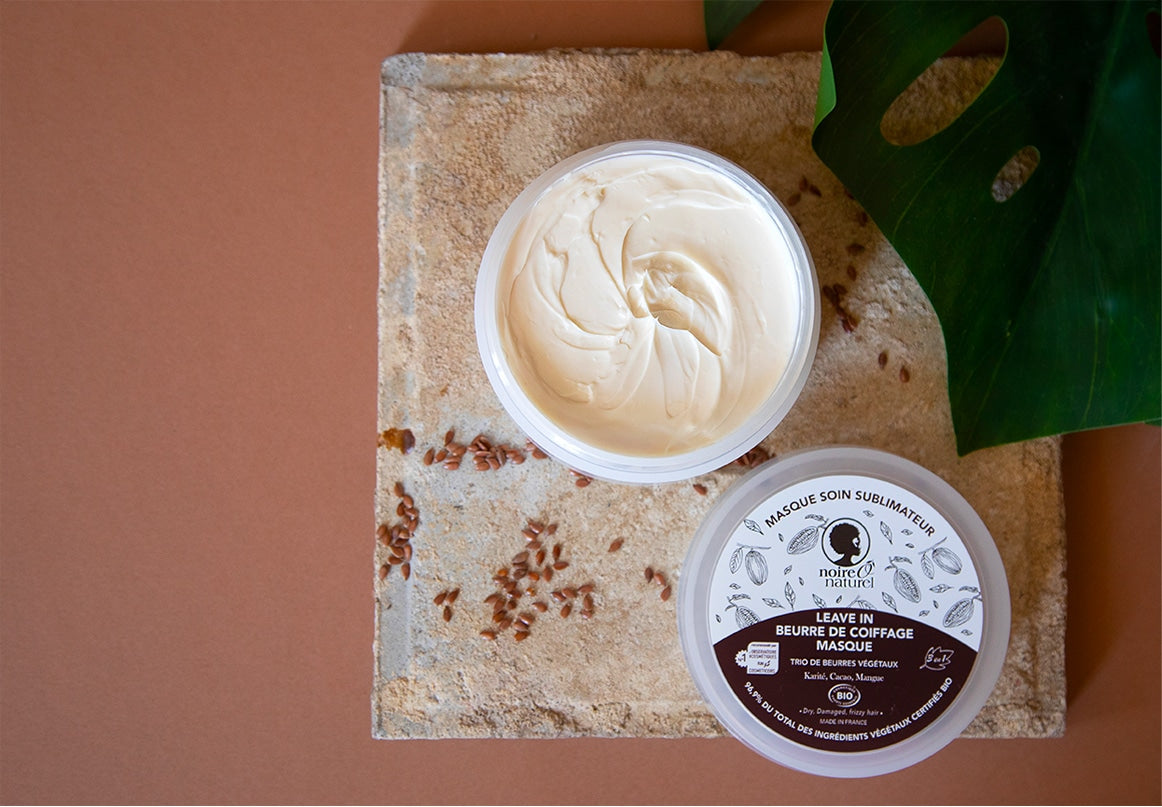
The genesis of an exceptional treatment for deeply regenerated hair! After telling you how our sulfate-free shampoo cream was born, here's how the noireÔnaturel Sublimating Care Mask was dreamed up...
Hair and hairstyles in general are very important for black women; they are the primary adornment of their beauty. The ancient rituals surrounding Afro hairstyles illustrate this. © Okhai Ojeikere ...


Leave a comment
All comments are moderated before being published.
This site is protected by hCaptcha and the hCaptcha Privacy Policy and Terms of Service apply.